
The Hidden Spiritual Circuit of Uttarakhand: Lord Jagannath of the North & The Mythological Sapt Badri Temples
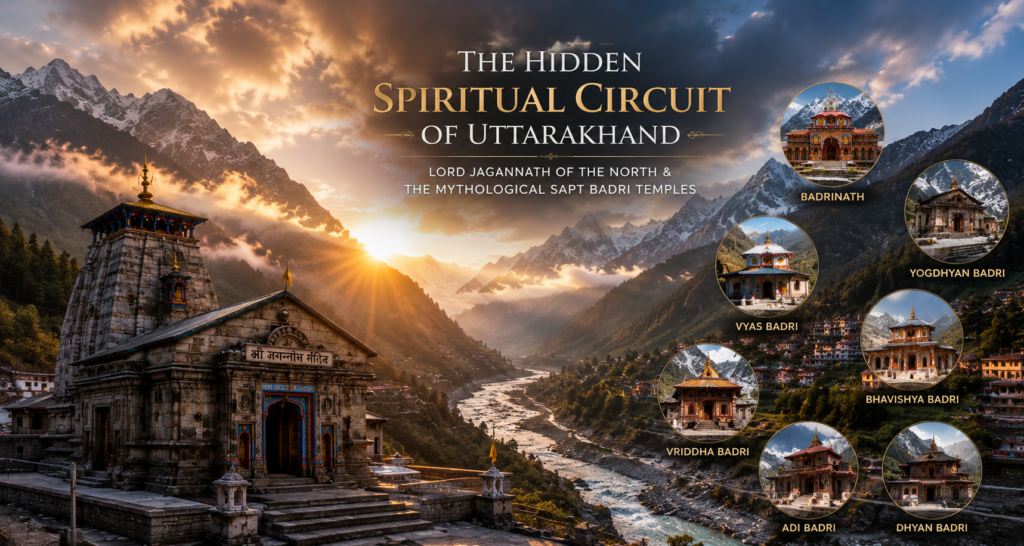
The pristine valleys of Uttarakhand are witnessing a massive influx of global pilgrims during the annual Chardham Yatra. While millions journey toward the primary abodes of Gangotri, Yamunotri, Kedarnath, and Badrinath, some of the most profound spiritual treasures remain safely tucked away as hidden gems along the route.
If you want to truly absorb the divine energy of the Himalayas and discover sacred sites that escape the common eye, you must experience the Lord Jagannath Temple of the North in Uttarkashi and the legendary Sapt Badri Temple Circuit in Chamoli.
Part 1: Mahaprabhu Jagannath of the North (Sald Village, Uttarkashi)
The Mythological Legacy of Sald Village
Located gracefully on the banks of the historic Varuna River, just 7 kilometers away from the main town of Uttarkashi, sits the 12th-century Lord Jagannath Temple in Sald Village. Local Vedic scriptures and folklore state that visiting this mythological temple bestows the exact same spiritual merit (Punya) as a pilgrimage to the world-renowned Puri Jagannath Dham in Odisha.
The roots of the temple trace back to the era of the Mahabharata. It is believed that Santati Karna performed rigorous penance here to be blessed with offspring. Pleased by his devotion, Lord Jagannath manifested in the village in the playful form of a young child, playing ball with local children before merging into the sacred soil. Recognizing the sanctity of the location, the great philosopher-saint Adi Shankaracharya later visited the site, formally consecrating the divine idol of the deity.
🌾 Cult-Cultural Tradition: The Holy Red Rice Prasada
Mirroring the grand kitchen traditions of Puri, the offering (Prasada) prepared here carries great importance. The residents of Sald Village cultivate an organic variety of indigenous Red Rice (Lal Chawal). The raw grain is ceremoniously presented to Lord Jagannath, cooked over traditional wood fires, and distributed to devotees. Consuming this sacred rice is believed to clear the body and spirit of worldly impurities.
Creating the Ultimate Uttarkashi Spiritual Circuit
Uttarkashi is globally celebrated as the “Kashi of the North”. When planning your trip to the Jagannath Temple, you can smoothly explore a cluster of adjacent ancient shrines:
- Kashi Vishwanath Temple: A majestic architectural marvel housing a powerful Shiva Lingam.
- The Shakti Temple: Located directly across from Vishwanath Temple, it houses a massive, ancient metal Trident (Trishul) that symbolizes supreme divine energy.
- Secondary Shrines: The town complex features ancient temples dedicated to Parashuram, Bhairav, and other Vedic deities.
- Joshiyara Lake: For relaxation, the nearby Joshiyara Lake offers water sports and serene boating opportunities managed by the local administration and Naveen Paryatan Sansthan (Nimi). The Jagannath temple is located a mere 150 meters from the boating area.
Part 2: The Mystical Sapt Badri Temples (Chamoli District)
As your journey snakes into the high-altitude terrains of the Chamoli district, you enter the ancient Badri Kshetra—the holy realm of Lord Vishnu. While Badrinath Dham is universally famous, true explorers look to complete the Sapt Badri Yatra, a collection of seven sacred Vishnu temples hidden among serpentine rivers and cascading waterfalls.
Apart from Badrinath and Bhavishya Badri, which close down for the harsh winter months, the remaining five shrines stay accessible to devotees all 12 months of the year.
[SAPT BADRI CIRCUIT COMPREHENSIVE ROAD MAP]
(Karnaprayag) ———> (Helang / Urgam Valley)
| |
[1. Adi Badri] [4. Dhyan Badri]
| |
(Animath Village) (Pandukeshwar)
| |
[2. Vriddha Badri] [5. Yog-Dhyan Badri]
| |
(Joshimath) [6. Badrinath Dham]
| |
[3. Narsingh Badri] (Subhain Village)
|
[7. Bhavishya Badri]
The Seven Sacred Manifestations of Lord Vishnu:
- Badrinath (Badri Vishal): The primary throne of the circuit, located between the majestic Nar and Narayana mountain peaks under the shadow of Neelkanth Parvat. The magnificent four-armed idol of Lord Vishnu carved out of pure Shaligram stone sits here in deep meditation.
- Adi Badri: Located 17 kilometers from Karnaprayag on the ancient Ranikhet highway. This site features a historic complex of 16 ancient stone temples constructed during the rule of the Garhwal Dynasty, with 14 perfectly intact today. It marks the starting threshold of the Sapt Badri yatra.
- Vriddha Badri: Situated at an altitude of 1,380 meters in the scenic Animath village (7 km before Joshimath). This is the exact site where Lord Vishnu manifested as an old man (Vriddha) before the sage Narada Muni. Adi Shankaracharya offered prayers here before establishing the deity at the main Badrinath Dham.
- Bhavishya Badri: Positioned on the scenic Joshimath-Malari route beyond the serene hot springs of Tapovan, near Subhain village. Puranic prophecy dictates that at the end of the Kaliyuga, natural cataclysms will block the paths to the main Badrinath, and Lord Vishnu will be permanently worshipped right here at Bhavishya Badri.
- Yog-Dhyan Badri: Located at Pandukeshwar, this ancient temple houses Lord Vishnu in a meditative posture. Legend states that King Pandu (father of the Pandavas) performed rigorous penance here. This site serves as the crucial winter home for the festival deity (Utsav Murti) of Badrinath when the main high-altitude temple shuts down due to snow.
- Dhyan Badri: Tucked away in the mesmerizing Urgam Valley close to the Kalpeshwar Panch Kedar shrine, sitting peacefully on the banks of the Kalpa Ganga river. It features an ancient black stone idol of Vishnu in an absolute state of yogic absorption (Dhyanavastha), built under the spiritual guidance of Adi Shankaracharya.
- Narsingh Badri (Joshimath): Located in the heart of Joshimath, this ancient temple serves as the winter seat of Lord Badrinath. The temple features a unique idol of Lord Narsingh (the lion-faced incarnation of Lord Vishnu). Local lore warns that the left arm of this ancient stone idol is becoming progressively thinner over the centuries.
Part 3: Comprehensive Route, Distance & Travel Matrix
Reaching these hidden shrines is highly practical via well-constructed highway networks connecting major transport hubs across Uttarakhand:
|
Destination Sanctuary |
Base Distance Matrix (Approximate) |
Route & Travel Specifications |
|
Sald Village Jagannath Temple |
165 km from Rishikesh 140 km from Dehradun 7 km from Uttarkashi town center |
Traveled comfortably by car/bus via NH 34. The shrine is easily accessible with zero arduous mountain trekking required. |
|
Adi Badri Complex |
17 km from Karnaprayag |
Easily accessible via the smooth Karnaprayag-Ranikhet motorway. |
|
Vriddha Badri |
7 km before Joshimath town center |
Situated conveniently in Animath village directly off the main national highway. |
|
Bhavishya Badri |
17 km from Joshimath |
Drive up to Saldhar/Tapovan valley followed by a scenic trek into the thick woods of Subhain village. |
|
Dhyan Badri |
7 km from Helang Chatti |
Turn off the main highway at Helang toward the spectacular Urgam Valley. |
Accommodations and Local Mountain Cuisines
To handle the growing wave of modern spiritual travelers, both the Uttarkashi and Chamoli regions boast exceptional tourism facilities. There are more than 200 modern hotels, boutique tourist guest lodges, traditional ashrams, and registered eco-homestays operating across these valleys.
Staying at a registered mountain homestay allows you to taste genuine Pahari Cuisines cooked traditionally over slow wood fires using organic local ingredients harvested straight from the adjacent step-farms. Travelers are advised to plan at least a 10-day specialized travel itinerary to completely explore these paths without haste.